

Table of Contents
In the early 20th century, a pair of extraordinarily tall men from Kashmir captured global attention. Known today as the Kashmir giants, these towering figures stood well over seven feet tall and became one of the most talked-about spectacles at a grand imperial celebration in British India.
Short answer: The exact dates of death for the Kashmir giants are unknown. Historical records do not clearly document when the brothers died, which has only added to their mystique.
A Spectacle at the Height of Empire
The story of the Kashmir giants begins in 1903, during one of the most elaborate ceremonial events of the British Empire. The Delhi Durbar was organized to celebrate the coronation of King Edward VII, following the death of Queen Victoria in 1901.
Although the king himself never traveled to India, the event was anything but modest. Lord Curzon, then Viceroy of India, orchestrated a lavish display meant to showcase imperial authority and wealth. The gathering brought together royalty, military units, and dignitaries from across the subcontinent.
This moment sits within the political landscape during the medieval period’s long aftermath, as older regional traditions blended uneasily with British imperial rule.
The Unexpected Stars of the Durbar
Amid dazzling jewels, decorated elephants, and grand processions, two figures stood out above all others. Quite literally.
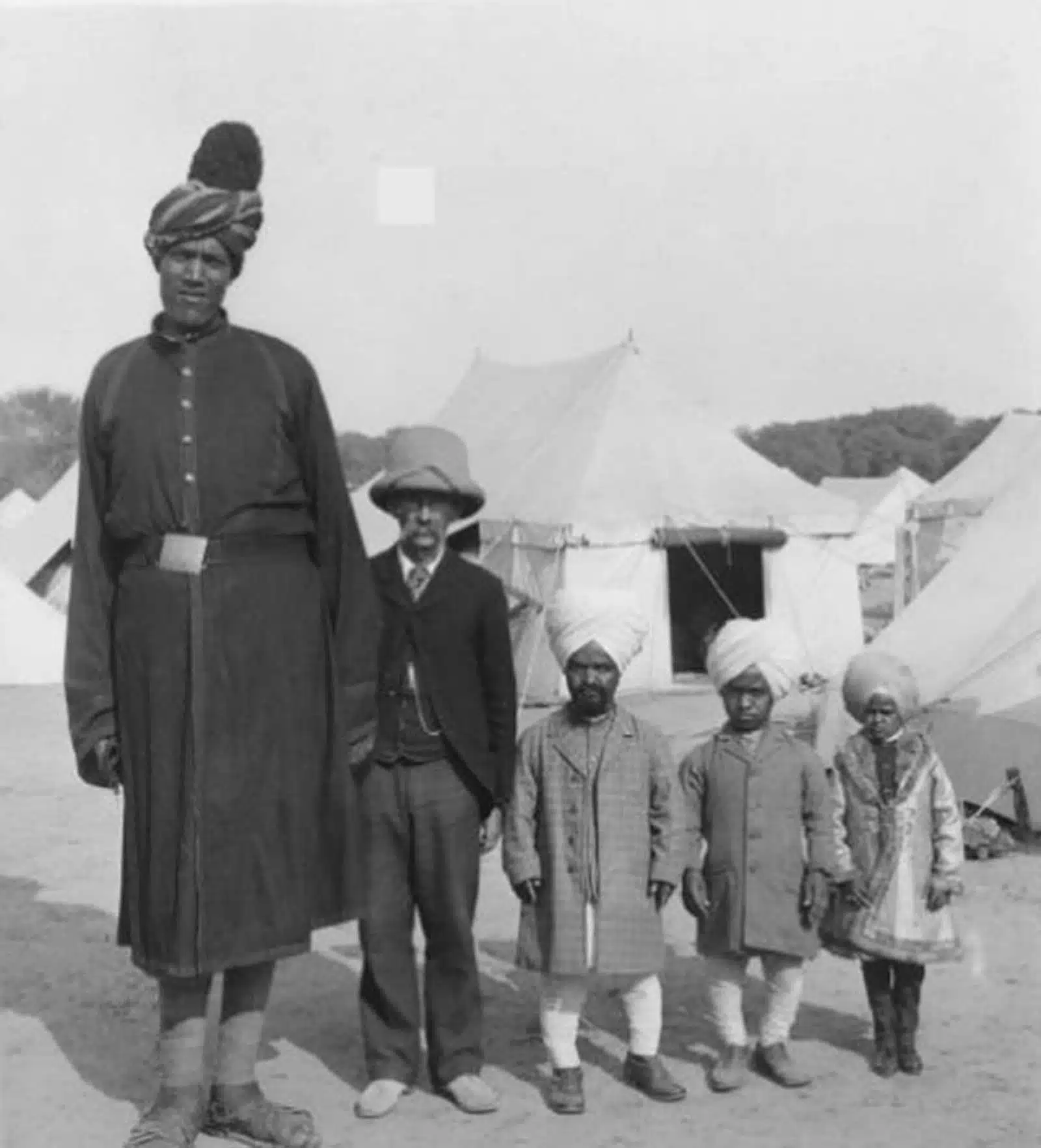
The Kashmir giants were reportedly twin brothers serving in the army of the Maharaja of Jammu and Kashmir. Their heights were astonishing:
- One measured around 7 feet 9 inches
- The other stood approximately 7 feet 4 inches
At a time when the average height was far shorter, their presence drew immediate fascination. Crowds paused. Observers stared. And photographers took notice.
Captured on Camera: James Ricalton’s Photographs
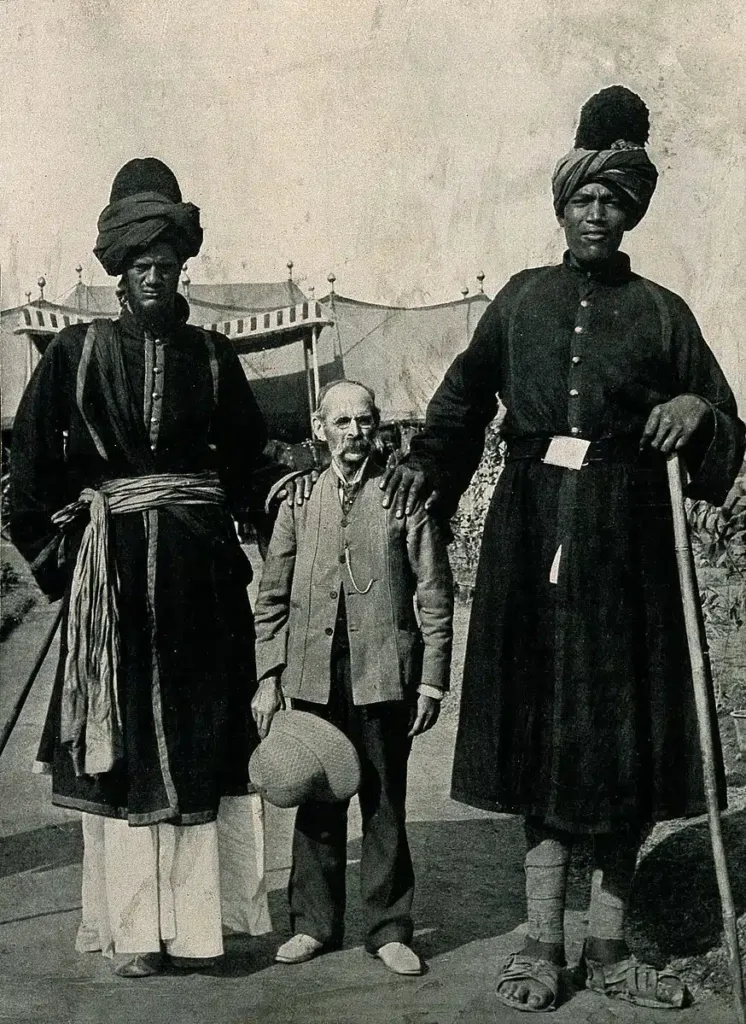
One of the most important reasons we remember the Kashmir giants today is the work of James Ricalton, an American photographer and educator. He traveled to India specifically to document the Durbar.
Ricalton didn’t just photograph the pageantry. He focused on human subjects that told a story. The giants became a central part of his visual record.
In several striking images:
- Ricalton appears dwarfed beside the brothers
- In one pose, he sits between them, barely reaching their chest level
- In another, their hands rest on his shoulders, emphasizing their scale
Without these photographs, their story might have sounded exaggerated. With them, the reality becomes undeniable.
Where Did the Kashmir Giants Come From?
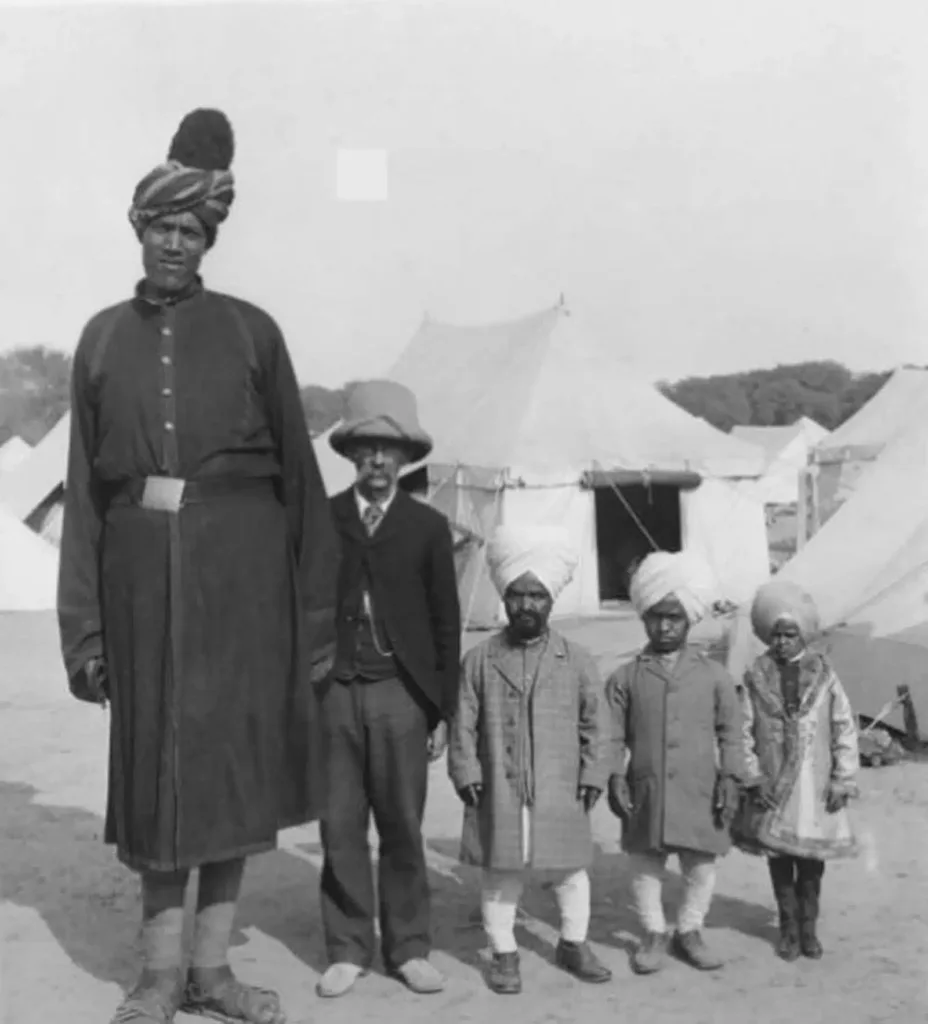
Contemporary reports suggested the brothers were from a place called Balmokand. However, historians have struggled to identify this location on modern maps.
It is possible the name changed over time, or that it was recorded incorrectly by foreign journalists. Either way, the uncertainty adds another layer to their story.
They were not independent performers or curiosities. Instead, they served as part of a royal retinue, likely valued for both their physical presence and symbolic power.
Global Fascination and Media Coverage
The Kashmir giants quickly became international news. Journalists who attended the Durbar carried their story across continents.
An Australian publication famously described them in an article about the Maharaja’s entourage. Readers were captivated by the idea of men who seemed to defy normal human proportions.
This period saw growing interest in key historical figures from the region, and while the giants were not political leaders, they became cultural icons almost overnight.
Myth, Memory, and Missing Details
Despite their fame, much about the Kashmir giants remains unclear. No widely accepted names have survived in historical records, and key details about their lives are missing.
One question appears frequently: when did the Kashmir giants die?
The truth is simple. We do not know.
There are no confirmed records documenting their deaths, burial places, or later lives. Unlike rulers or military leaders, they left behind little written trace beyond photographs and scattered news reports.
This lack of information has allowed their story to drift toward legend. They exist somewhere between documented history and folklore.
Why the Kashmir Giants Still Matter
It would be easy to dismiss the Kashmir giants as a historical curiosity. But their story reflects something deeper.
They appeared at a moment when the British Empire was at its height, during a carefully staged display of power. Yet it was not the imperial officials or the ceremony itself that captured the public imagination most strongly. It was two individuals whose physical presence challenged expectations.
Their legacy also connects to events transitioning into early modern times, when photography began shaping how people understood distant places and cultures.
Through Ricalton’s lens, the giants became more than participants in a parade. They became enduring symbols of the unexpected.
FAQ: The Kashmir Giants
Who were the Kashmir giants?
The Kashmir giants were two exceptionally tall brothers from the region of Jammu and Kashmir who served in the Maharaja’s army and gained fame during the 1903 Delhi Durbar.
How tall were the Kashmir giants?
One brother was about 7 feet 9 inches tall, while the other stood around 7 feet 4 inches, making them among the tallest recorded individuals of their time.
When did the Kashmir giants die?
Their exact dates of death are unknown. Historical records do not provide clear information about when or how they died.
Why are the Kashmir giants famous?
They became famous due to their extraordinary height and photographs taken by James Ricalton during the Delhi Durbar, which circulated internationally.
Were the Kashmir giants real?
Yes, photographic evidence and contemporary reports confirm their existence, although many details about their lives remain uncertain.
